Juan Soto is the undisputed crown jewel of free agency. He has been one of the top names in baseball since his debut in 2018 and he is expected to sign one of the largest free agency contracts in history during the upcoming offseason. Small market teams will not have the means to sign the available outfielder, and the owners of some mid and large market teams will not be able to stomach the investment required to lure him. This leaves most of baseball watching the Soto Sweepstakes from the dugout.
Luckily, you do not have to break the bank to win in the MLB. In fact, eight of the last twenty World Series champions were teams outside of the top ten in payroll. There are many available free agents who could be key pieces for teams on the cusp of competing or who could be the veteran pieces needed to push a young team with playoff dreams to the next level. We will discuss three players who could be a good fit at the right price for your team.
Willy Adames
The traditional baseball paradigm is to build a team up the middle. Because of this, free agent shortstops have been highly sought after in recent years. The valued piece in this year’s market is Milwaukee standout Willy Adames.
There is much conjecture about where Adames’s contract value will land this offseason. He has been a productive hitter (118 OPS+ in 2024 and 113+ during his time in Milwaukee). He has also been a good defender, with his OAA ranging from above average to Gold Glove caliber.
Comparing Adames to other shortstops who recently signed free agent deals can provide a reasonable range to estimate. Carlos Correa, Francisco Lindor, and Corey Seager all had significantly higher offensive production than Willy Adames in the years prior to their free agency. Seager and Lindor received ten-year contracts that exceeded $300 million, while Correa received a shorter (six-year) contract with a similar average annual value due to concerns about his health during medical examinations. Adames will likely not receive a similar contract because he does not provide the same level of offensive output as the others, and he does not consistently play the Gold Glove caliber defense that Lindor and Correa displayed prior to their free agency.
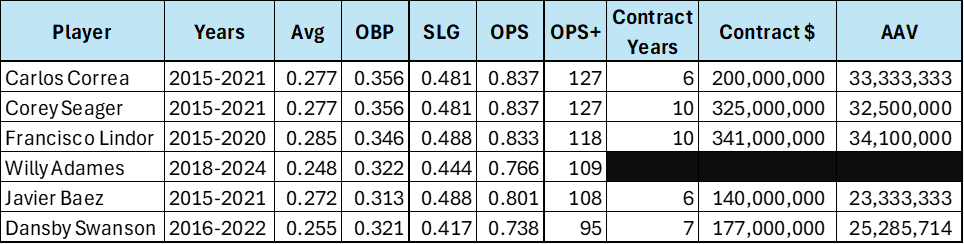
(Statistics are from the players’ careers prior to signing their first free agent contracts.)
The more interesting comparisons are to Javier Baez and Dansby Swanson. Both players are Gold Glove winning shortstops who were instrumental in winning World Series Championships with their original teams. However, teams did not see them as the surefire cornerstones that netted the other comparable shortstops $30 million a year deals. Baez was an above league average hitter with tremendous power upside for the Cubs, but teams had legitimate concerns about his chase and whiff rates (which have materialized since his deal). There were never concerns regarding Swanson’s defense in Atlanta. Swanson showed offensive promise, however, his cold spells and streaky bat resulted in a below league average OPS during his time on the Braves. This resulted in shorter deals and a lower average annual value for both players (still bringing in over $140 million total respectively).
Adames is a great shortstop and a great baseball player. He is not quite the caliber of Lindor, Correa, and Seager as they approached free agency, however, he is a very consistent hitter that does not present the concerns that Swanson and Baez did. He falls somewhere in the middle of the previously discussed shortstops. He could be the steal of the offseason if the market dictates that his contract value is closer to the Baez and Swanson range than that of Correa, Lindor, and Seager.
Joc Pederson
You better be able to hit if you are a player who does not play the field and must occupy the designated hitter spot in a lineup. Many teams choose not to slot one specific player at DH for good reasons. It gives teams the flexibility to keep an injured player in the lineup without having to endure the physical demands of playing the field. Also, teams use the DH spot to give players rest with pseudo days off while keeping their bat in the lineup. It also allows teams to utilize the defensive versatility of players to open roster spots to address other weaknesses.
Sometimes the benefits of having a standout offensive producer at DH can outweigh the benefits of rotating players into the DH spot. Shohei Ohtani, Yordan Alvarez, Marcel Ozuna, Kyle Schwarber, and Brett Rooker are examples of designated hitters whose offensive production allows them to be productive full time DHs. But there is another player who might not be top of mind who deserves a seat at the table.
Pederson is a standout hitter against right-handed pitchers. He posted a .923 OPS and 154 OPS+ against right-handed pitching in 2024. How does this compare to other lefty DHs facing right-handed pitching?
Shohei Ohtani is by far the best left-handed DH in baseball. Yordan Alvarez is widely regarded as one of the scariest hitters for any pitcher to face. Kyle Schwarber is known as a top tier DH and the table-setter for the loaded Phillies lineup. I have compared Pederson’s statistics to those of the three previously mentioned DHs. I also included Ryan O’Hearn’s statistics. He will also be a free agent competing with Pederson for a contract. Pederson’s statistics rank favorably among this group.
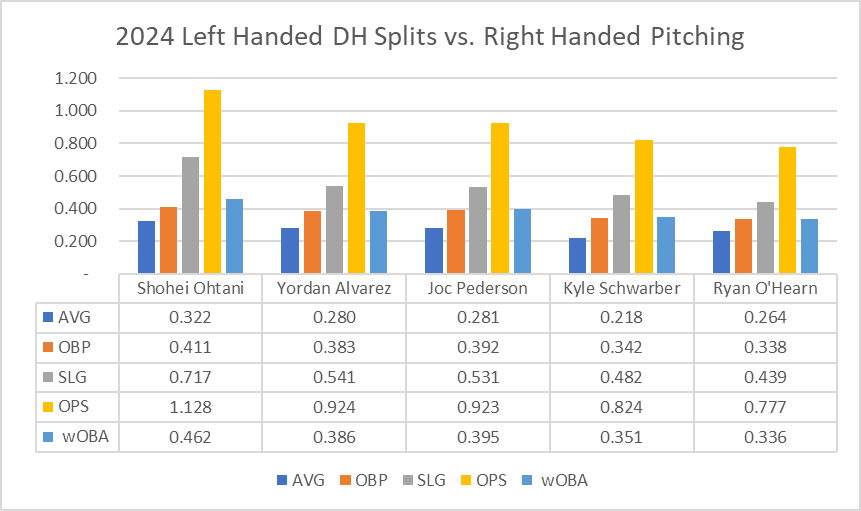
Ohtani has far and away the best statistics of the bunch, which comes as no surprise. Alvarez’s and Pederson’s numbers facing righties are almost identical. Alvarez has a 10-point edge in slugging while Pederson gets on base at a 9-point higher clip. Pederson trails Alvarez in OPS by .001 and edges him in wOBA. Pederson’s offensive output against righties surpasses both Schwarber’s and O’Hearn’s.
Joc Pederson has one shortcoming that the other comparable DHs do not possess. He posted a 124 WRC+ against left-handed pitching in 2024, but this came in a small sample of 42 plate appearances. In fact, Pederson has only logged more than one hundred plate appearances against lefties twice since his career began in 2014. His on base splits are on par with his total on base percentage. However, his slugging is consistently lower against left-handed pitching. This has led to Pederson having a platoon role over the course of his career.
His age (currently 32), platoon concerns, and lack of defense are issues that will necessitate additional versatile right-handed hitting roster pieces. However, this could prove a useful negotiating chip for teams to get his production at a valuable price. Joc Pederson has a mutual option for $14 million with Arizona in 2025. Ohtani’s production is unrivaled but comes with a $700 million price tag. Alvarez and Schwarber’s contracts carry average annual values of $19.17 million and $19.75 million, respectively. The $14 million option with Pederson’s production would be a good contract for Arizona. However, Pederson might play the market. A team might find significant value if he is open to a multiple year deal near his current AAV of $12.5 million.
David Robertson
The development of pitcher evaluation has rapidly enhanced with the tools and analytics available in today’s game. Pitching, once seen as an art of changing speeds and deceiving hitters, has become more science and engineering with data allowing pitchers to improve their current arsenal while developing new weapons at a rate we have never seen before.
The overall goals for pitchers have remained consistent over time despite scientific advancements and data analytics in modern pitching. Getting outs and preventing runs still determine a pitcher’s success. Few bullpen arms have been able to execute as well and as consistently as David Robertson.
Robertson has a mutual option with the Texas Rangers for $7 million in 2025. However, he might decline this option and explore free agency. There may be hesitation to sign a free agent arm going into his age 40 season. Age can be a risk factor for a decrease in production. It may also be a red flag that Robertson has played for six teams in four years. However, Robertson has consistently pitched well out of the bullpen. He posted a 2.92 ERA and 143 ERA+ after recovering from Tommy John surgery in the back half of the 2021 season, performing on par with his pitching prior to the procedure (2.90 ERA and 145 ERA+).
Robertson posted a 3.00 ERA in 2024. The analytics show that he is still an elite relief pitcher. He posted a 33.3% strikeout rate in 2024, which put him in the 96th percentile of all pitchers. Sixty six of his ninety-nine strikeouts came as a result of his elite cutter. This pitch ranked among the top ten individual pitches in terms of run value (19) in the 2024 season.
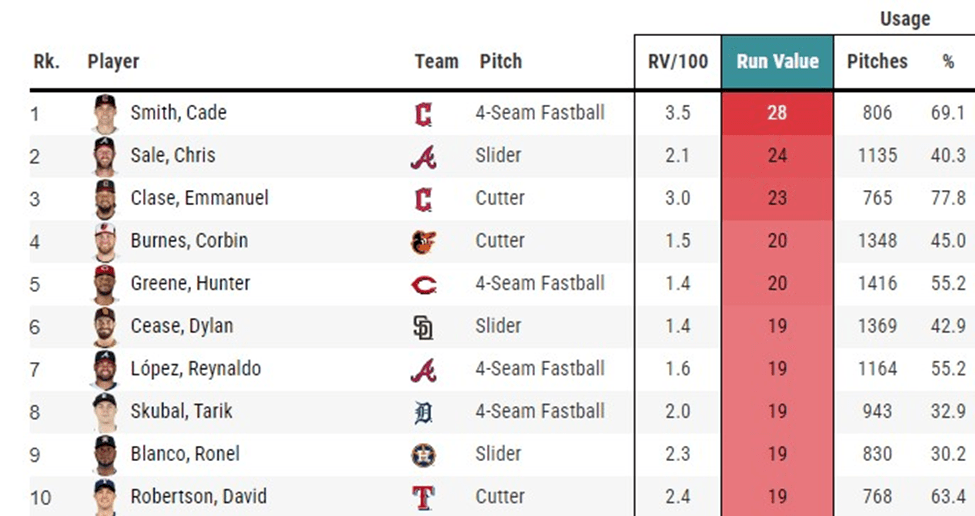
The run value of Roberton’s cutter tied that of Tarik Skubal’s fastball which helped the imminent AL Cy Young winner attain the Triple Crown. It also equaled Padres ace, Dylan Cease’s, slider which helped him finish third in the MLB in strikeouts. The other two pitches with a nineteen run value were Ronel Blanco’s slider and Reynaldo Lopez’s fastball. Blanco finished fourth among qualified starters in ERA, while Lopez finished with an impressive 1.99 ERA (but did not throw enough innings to qualify among the league leaders).
Robertson’s production at his age is still on par with his career averages and his cutter is an elite-level pitch. He also brings the intangibles of experience as a high-level closer that can prove valuable in case of injury and as an example for younger and inexperienced bullpen arms. Non-closer bullpen signings are not always on fans’ wish lists. However, Robertson’s production and consistency provide a “set it and forget it” bullpen arm that is valuable to any team willing to sign him.

 31 Baseball
Leave a comment