Catching is arguably the most important defensive position in baseball. There are many ways in which catchers impact the game on defense. They work with the pitching staff to call pitches, impact count leverages through pitch framing, and prevent extra bases by blocking balls in the dirt and throwing out runners. During the past decade, catchers’ pitch framing and “strike stealing” abilities have been considered more valuable than their ability to prevent extra bases (via blocking balls in the dirt or throwing out runners). However, with recent rule changes compelling teams to be more aggressive stealing bases, there should be more emphasis placed on the catcher’s ability to slow down the running game in the calculation of run prevention metrics.
Why is Strike Stealing Valuable?
Baseball has changed significantly over the past decade. One visible difference is the way catchers set up to receive pitches. The traditional catcher’s squat has given way to the one-knee down setup. This allows catchers to sit lower in their stance. The one-knee down positioning allows the catcher to stay on the plane of lower pitches, allowing him to frame balls that fall below the zone and present them as strikes.
Catching pitches that are balls close to the zone in a way that gets more called strikes is an art form that is inherently valuable on a pitch-by-pitch basis. The difference between a called ball and called strike can have drastic effects on count leverage and can even determine the outcome of a plate appearance. For example, the statistics below show all 2024 pitches in 1-2 counts and 2-1 counts. The statistics (batting average, on base percentage, and slugging) are significantly better for hitters in 2-1 counts, including a 6-run increase in batter run value. Teams can put their pitchers in advantageous situations more often if a catcher can effectively frame pitches. The ability to impact count leverages over the course of a season makes pitch receiving and framing extremely valuable when evaluating a catcher’s defense.
2024 League Statistics in 1-2 Count


The Trade-Off: Receiving vs Blocking and Throwing
The value of having a catcher with elite receiving ability cannot be understated. Teams try to take advantage of the value of framing. And to do this, newer techniques, and strategies (such as the one-knee catching stance), have been adopted by catchers throughout baseball. There are advantages and disadvantages associated with these changes. For example, the one-knee down stance inhibits the catcher’s ability to block balls in the dirt and to throw out runners attempting to steal bases.
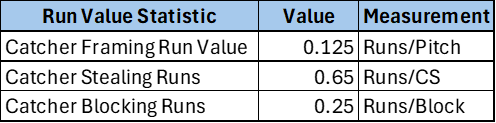
Why do organizations value pitch framing over throwing out runners stealing? This trade-off is made due to run value. Run value aims to measure the value of any single event in a baseball game. For instance, the average change in ability to score a run for converting a borderline ball into a strike is 0.125 (or 12.5 runs for every 100 events). The chart above shows the run values associated with framing, throwing out base stealers, and blocking, respectively. Although the value per event is the lowest for framing, this measurement is on a per-pitch basis. Over time, there will be significantly more framing events than that of blocking or caught stealing. Therefore, framing has the largest impact on run prevention (based on run value) over time.
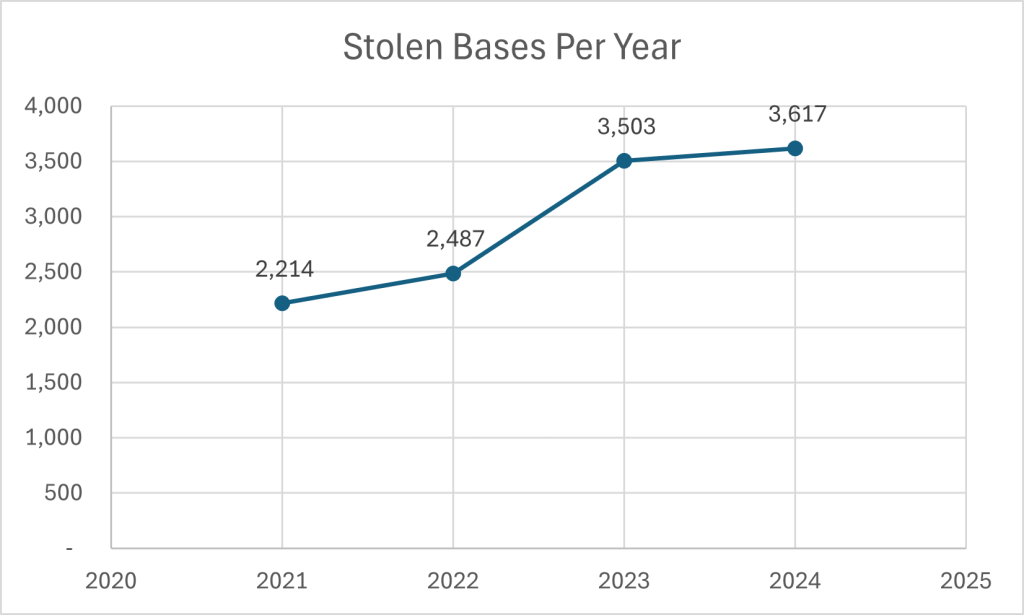
The number of stolen bases increased 39% between 2021 and 2024. The number had been increasing but shot up significantly in 2023 due to newly implemented rules including the pitch clock, larger bases, and pitcher disengagement limits. These rules, along with defensive shift restrictions (also implemented in 2023), are placing a larger emphasis on player athleticism at the major league level. As teams employ more athletic players, the number of stolen bases is likely to continue rising. If this trend continues, the gap between catcher run values for framing and throwing will likely narrow significantly.
What Should Be Done Going Forward?
Despite the above discussion, we should not completely overhaul the framework that determines which skills are valuable or overall technique changes behind the plate. However, there should be a heavier emphasis placed on throwing runners out. Catchers should have the ability to shift techniques and focus in situations when runners are in base stealing situations. One potential solution would be for catchers to utilize a more athletic stance when there are runners on base. This would enhance the catcher’s ability to block pitches in the dirt and to throw out runners attempting to steal.
There should be a balance between a catcher’s ability to frame pitches and their ability to control the running game. The current one-knee down stance is not conducive to blocking or throwing out base stealers. Catchers should implement a hybrid stance which allows them to not only effectively frame pitches but also optimize their pop time. Pop time is the time elapsed from the moment the catcher receives the pitch to the moment the intended fielder is projected to receive his throw.
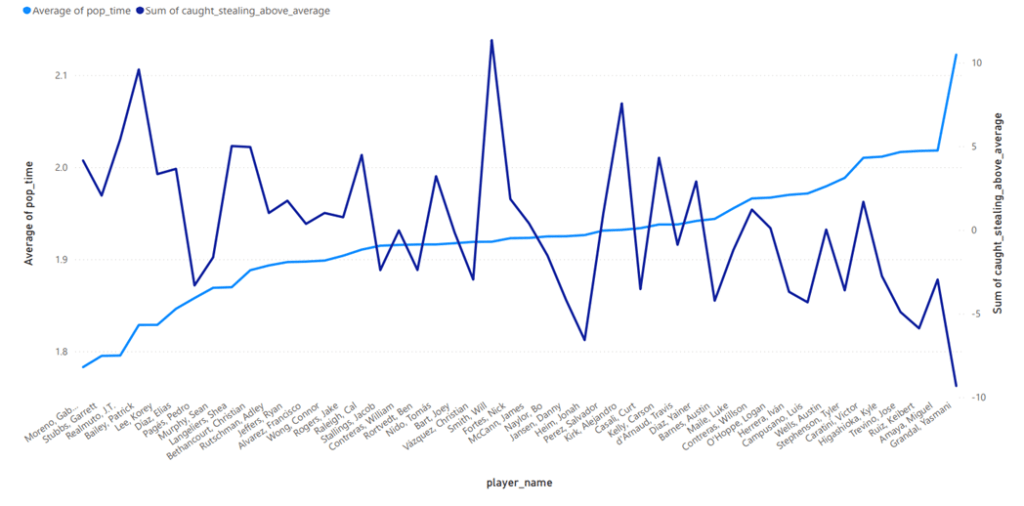
The graph above shows the throwing statistics for major league catchers with over thirty base stealing attempts against in 2024. The lighter blue line shows the average pop time for each catcher. The darker blue line shows the caught stealing above average. The overall takeaway is that faster pop times tend to lead to more outs. There is some variability due to the reliance on a pitcher’s time to the plate and other factors. The best way for catchers to control the running game is for them to implement techniques that lead to faster pop times.
Overall, the value metrics for catchers should consider the increasing number of stolen bases seen across the league. Pitch framing still has a greater impact on run value than throwing out base stealers because framing creates an impact on a pitch-by-pitch basis, leading to more opportunities to add value. However, the increasing stolen base totals present a growing opportunity for catchers to add defensive value to their teams. It is imperative that catchers employ strategies which allow them to effectively frame pitches, block balls in the dirt, and throw runners out.
 31 Baseball
Leave a comment