
This article is a continuation and part of a series discussing the most underrated players at each position based on batter run value. The link to the first article in the series, which includes the topic introduction, is linked below:
Second Base
Luis Garcia Jr.: 16 Batter Run-Value, 0.7 RV/100
Washington Nationals fans are excited about their young core heading into 2025. They got their first taste of top prospects Dylan Crews and James Wood in 2024, both seem to be budding superstars who will be cornerstones in their lineup for years. Shortstop CJ Abrams was an All-Star in 2024 and, despite off-field concerns at the end of the season, he is also a promising young player. These players are seen as the building blocks for the Nationals’ potential ascent into contention in one of the most challenging divisions in baseball. Luis Garcia Jr. is another talented young player on the team. He is a key piece of the team’s success, however, he does not get the recognition he deserves.
Garcia posted the fourth-highest run value of any second baseman during 2024. During the campaign, this mark trailed only Ketel Marte, Jonathan India, and Jose Altuve. For context, Marte finished third in NL MVP voting and was by far the best offensive second baseman in baseball during the 2024 season. Jose Altuve is a former MVP and one of the most recognizable players in the sport, and his 2024 OPS+[1] of 126 was on par with his career average of 129. Garcia being in a place where he is among these elite names is impressive at such an early age.
Answering the question of what makes Garcia valuable as a hitter is tricky. There is no specific offensive tool that separates him from his peers. The only categories in which he ranks above the 80th percentile are the expected batting average, strikeout percentage, and fielding range on his baseball savant page[2]. However, he is above average in most of the remaining categories (he is slightly below average in bat speed and launch angle sweet spot rate). He is also in the bottom 11thpercentile of chase and whiff percentages. Garcia doesn’t do anything at an elite level, but he does many things well, which makes him a complete hitter.
[1]OPS+ is widely used to evaluate a player’s offensive performance. MLB’s glossary website states, “OPS+ takes a player’s on-base plus slugging percentage and normalizes the number across the entire league. It accounts for external factors like ballparks. It then adjusts so a score of 100 is league, and 150 is 50 percent better than the league average.” It allows you to look at one number to see how a player’s offensive output compares to the league average during a period while also accounting for the ballparks where they play most of their games. For instance, the statistic would adjust for a Colorado Rockies player who plays half of his games in the notoriously hitter-friendly Coors Field.
[2] Baseball Savant is a website run by Major League Baseball that contains databases of Statcast data. Per MLB’s glossary website, “Statcast is a state-of-the-art tracking technology that allows for the collection and analysis of a massive amount of baseball data, in ways that were never possible in the past. Statcast can be considered the next step in the evolution of how we consume and think about the sport of baseball, encompassing pitch tracking, hit tracking, player tracking and even bat tracking for all Major League games.”
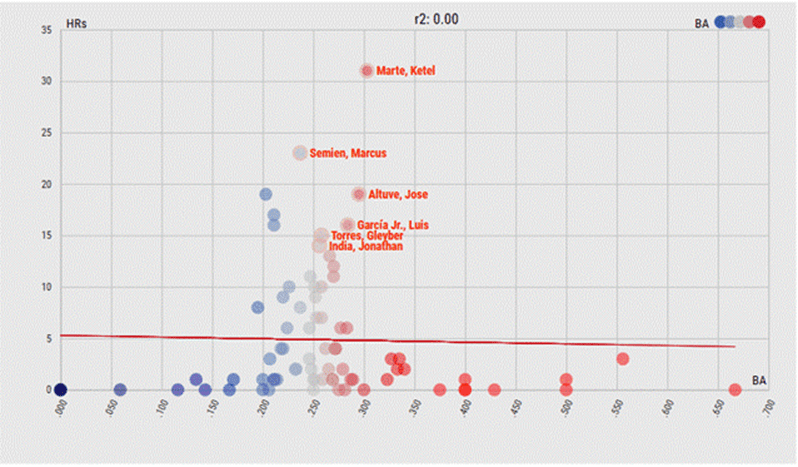
His hitting ability is apparent when comparing his traditional statistics to other second basemen. The graphic above shows batting average across the x-axis and home runs along the y-axis. Garcia is one of only three second basemen who hit for a combination of more than 15 home runs with a batting average between .250 and .300 (Ketel Marte is an outlier on this graph, hitting over .300 and slugging 31 of his 36 home runs while playing second base). His batting average, home runs, and run value make him one of the elite hitters at second base.
However, Garcia is not considered elite across the baseball landscape. We’ve already gone through some high-level prospects who gain more attention on their team. He also gets overshadowed when looking across the league. MLB Network shows a list of the top ten players by position each year using statistical analysis and feedback from the network’s team. Garcia did not crack the top ten on the MLB Network’s list. There is no gripe at the top of the list containing superstars like Ketel Marte, Jose Altuve, and Marcus Semien. The list also contains gold glovers Andres Jimenez and Nico Hoerner, who are lower on the list. Having players on the list with elite gloves at a “defense-first” position makes sense. However, Luis Garcia deserves more recognition for the highlighted offensive statistics while possessing above-average defensive metrics.
Shortstop
Carlos Correa: 28 Batter Run-Value, 2.0 RV/100
The MLB has a glut of talent at the shortstop position. There has been an emergence of young prospects who have panned out at the big-league level. Players like Bobby Witt Jr., Gunnar Henderson, and Elly De La Cruz have taken the league by storm. Meanwhile, veteran mainstays like Francisco Lindor, Trea Turner, and Corey Seager continue to shine as some of baseball’s brightest stars. Willy Adames signed a massive seven-year contract with the Giants this offseason worth $182 million. Additionally, Mookie Betts transitioned to the position. There is no shortage of star power at the position.
It is easy for players to get lost in the shuffle, even for individuals with proven track records of success. Carlos Correa is one example of a shortstop overshadowed by the star power at the position. Correa burst onto the scene, winning the American League Rookie of the Year in 2015. Since then, he has made three all-star teams, won a platinum glove, and played a significant role for the Houston Astros 2017 World Series championship team. His career slash line is .275/.354/.517, resulting in a .826 and 126 OPS+. These offensive statistics and his ability to play above-average defensively at a premium position make him one of the elite players in the sport.
How does a player with such a track record become considered underrated? The answer lies in his resilience. Carlos Correa was a central figure, and possibly the most prominent villain, from the Houston Astros 2017 World Series team, whose accomplishments were tainted by the infamous sign-stealing cheating scandal. Despite this, Correa continued to perform at an elite level after the World Series. His resilience was tested when he played only 75 games during the 2019 season due to injury, and his offensive output fell short in the COVID-shortened 2020 season. However, he rebounded in 2021, posting impressive offensive statistics and a defensive run value of nine in his final season before free agency. At that time, Correa was still seen as one of baseball’s brightest stars, a testament to his ability to bounce back from setbacks.
Correa was poised to cash in with a big contract, entering free agency before the 2022 season. Many teams were interested in signing him to a long-term deal. The San Francisco Giants agreed to a 13-year, $350 million deal with Correa. For context, elite shortstop Francisco Lindor signed a 10-year, $341 million contract the year before. Whenever there is a report of a transaction, there is always the caveat of “pending physical.” The physical is usually a formality that never amounts to anything. However, Correa’s physical with the Giants resulted in concerns regarding his ankle. This cast doubt on whether his health would hold up over the long term of the contract. The findings of the physical set-off alarm bells throughout the MLB were that the Giants retracted their offer, and Correa ended up signing a 6-year, $200 million contract with the Minnesota Twins. Despite signing a sizeable multiyear deal, the injury concerns surrounding Correa along with the $150 million total value left on the table diminished Correa’s perceived value.
Correa put together a great first season with the Twins in 2022. He amassed 5.3 WAR[3]with a 138 OPS+ over 136 games. He played 135 games in 2023 but had his worst offensive year (94 OPS+) outside of the COVID-shortened season 2020. Correa entered 2024 with something to prove and got off to a hot start, slashing .310/.388/.517 and making the American League All-Star team. However, he developed plantar fasciitis, causing him to play in only 86 games.
[3] Wins Above Replacement (“WAR”) statistically measures a player’s value. For batters, the statistic takes a player’s run value hitting, baserunning, and fielding above the level of a replacement player (slightly below league average). There are some adjustments for a player’s position and other league factors. This is a widely used statistic to evaluate a player’s value.
How does Correa compare to his contemporaries at the shortstop position? One way to look at this is to take the top ten shortstops by run value in 2024 and compare their career 162-game average statistics. Correa compares favorably at WAR, OPS, OPS+, and home runs. He has the third-best average WAR of this group, which shows his offensive and defensive value, and he plays a premium position. He also ranks fourth in OPS+, which proves his offensive value.

One caveat to this analysis is that the players have varying service times during which they have accumulated their average statistics. The expectation is that younger players like Henderson, Witt Jr., Neto, and De La Cruz will improve their statistics as they become established big leaguers playing up to their potential. Conversely, it will be interesting to see the timing of the eventual decline in statistics as the other players age (all other players on the list are now in their 30s, except for Adames, who is currently 29). In conclusion, Correa should still be considered one of the game’s best shortstops. If he can play close to his career averages, he is still one of the most valuable players at one of baseball’s most important positions.

 31 Baseball
Leave a reply to Underrated MLB Players to Watch in 2025 (Center Fielder) – 31 Baseball Cancel reply