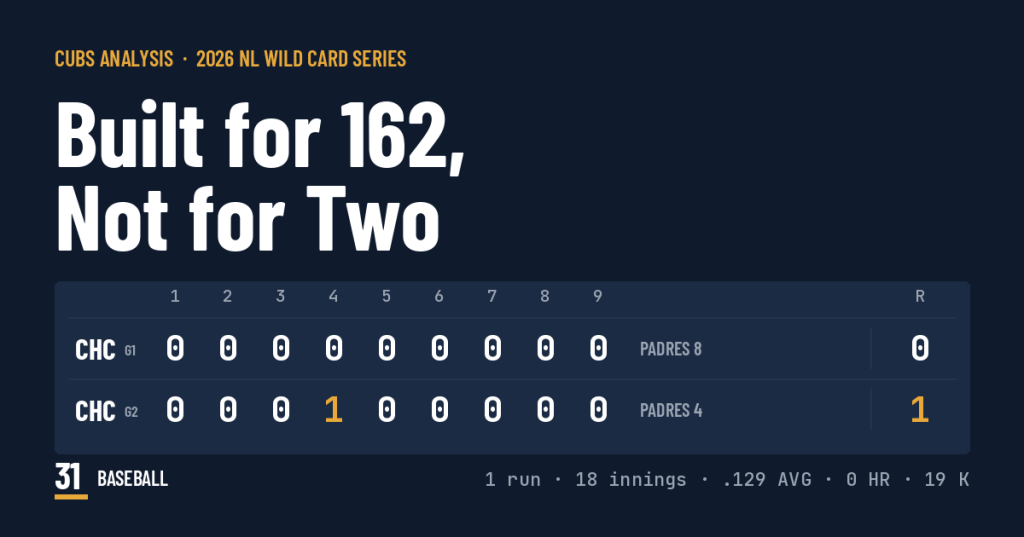
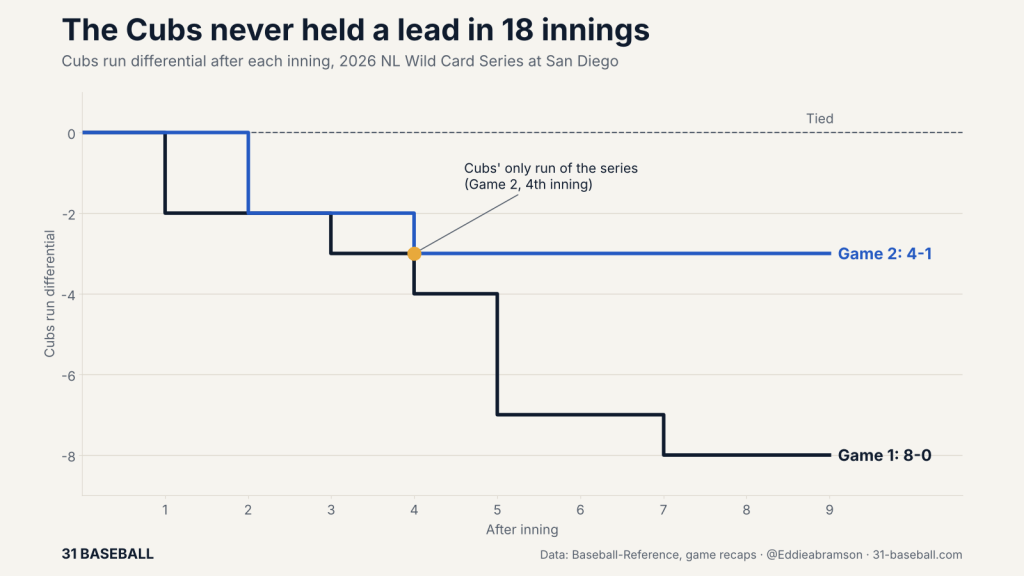
The Chicago Cubs had the highest-scoring offense in baseball in 2026. Pete Crow-Armstrong became the first Cub to join the 40-40 club, and as of mid-September no team in the majors had hit more home runs. Then the postseason arrived, and that offense scored one run in eighteen innings. The Padres swept the Cubs out of the Wild Card Series by scores of 8-0 and 4-1, and the Cubs did not hold a lead at any point in either game.
It is tempting to blame the bats and move on. The numbers are ugly: eight hits in 62 at-bats, a .129 batting average, zero home runs and nineteen strikeouts. Nico Hoerner had four of those eight hits and drove in the only run. Michael Busch and Dansby Swanson, who both carried this lineup for long stretches of the season, went a combined 0-for-11. Crow-Armstrong and Alex Bregman went 0-for-15 with eight strikeouts between them.
However, the offense did not lose this series on its own. The Cubs fell behind early in both games, and that put them in the one situation this roster was not built to handle.
Starting Pitching
Game 1 was effectively decided in the first inning. Fernando Tatis Jr. homered on the first pitch Matthew Boyd threw, and Manny Machado added a solo shot later in the inning. Boyd walked four batters in four innings, and four of the five hits he allowed went for extra bases. The bullpen did not stop the bleeding. Ryan Rolison allowed all three runners he inherited to score, and a passed ball and a throwing error helped the Padres pile on in a game that was already out of reach. Game 2 followed a similar script on a smaller scale. San Diego scored twice in the second inning and twice more in the fourth, and Kevin Gausman took the loss.
Michael King, meanwhile, carried a no-hitter into the seventh inning of Game 1. He struck out eight over seven scoreless innings. The Cubs had gone 5-1 against San Diego during the regular season, but they had not seen King, and it showed.
Trailing against an elite bullpen
This is where the series was really lost. Once the Padres had a lead, the Cubs were facing one of the best bullpens in baseball. San Diego’s relievers posted a 3.31 ERA this season, fifth in the majors, compared with 3.93 for the Cubs, who ranked thirteenth. Adrian Morejón struck out 107 batters in 86 innings with a sinker that averaged 99.5 mph, and Mason Miller waited at the back end. After the fourth inning of Game 2, the Cubs did not score again.
Against that kind of relief corps, a lineup built around the home run runs into a math problem. Elite relievers miss bats and limit hard contact. If you need three or four runs and your plan is to wait for a three-run homer, you need baserunners and you need contact, and the Cubs had very little of either. Nineteen strikeouts in two games is roughly 28 percent of their plate appearances.
To be fair to the home run, the research is not on the side of small ball. A 2020 study by Mike Petriello of MLB.com found that home runs accounted for 44 percent of postseason runs from 2010 to 2019, compared with 40 percent in the regular season, and that teams who out-homer their opponent win more often in October than they do over the summer. Postseason strikeout rates climb and offense drops because every team is throwing its best arms. Power still matters more in the playoffs, not less.
The real problem: no Plan B
That is why the issue is not that the Cubs should have bunted more. You cannot move a runner over if nobody reaches base. The issue is that this team, like most teams in today’s game, almost never practices the alternative. Bunts, hit-and-runs and productive outs fell out of favor because the analytics show they lower run scoring over a full season, and over 162 games that is the right call. But if a team never executes those plays from April to September, it is not going to trust them in a two-game series against a 99-mph sinker. The option is technically available, and practically gone.
The Cubs’ approach worked over the long regular season because their talent was good enough to overpower most of the pitching they faced. The postseason strips that away. Rotations shrink to the best three or four starters, and the bullpens are the deepest you will see all year. Hitters like Busch and Swanson, who are capable of carrying a team for weeks at a time, are also capable of going cold for weeks at a time, and a two-game series gives you no time to wait out a slump.
What it means for the offseason
The lesson for Jed Hoyer is not to tear down the offense. It is to build a roster that does not need everything to go right. That starts with the rotation, which could lose Shota Imanaga, Boyd, Gausman and Clay Holmes this winter, and the bullpen, which never gave this team a reliable answer in the ninth inning. It also means valuing hitters who can put the ball in play against elite velocity, and giving them reps in situational hitting during the season so the option exists when October arrives.
The Cubs were built to win 162 games. Next year, they need to be built to win two.
Data: Baseball-Reference, insidethepen.com, MLB.com, Sports Illustrated, ESPN, Bleacher Report.


Leave a Reply