On Friday night, the Milwaukee Brewers and Tampa Bay Rays open the 2026 World Series, and baseball is guaranteed a first-time champion. Milwaukee won a major-league-best 103 games and swept the two-time defending champion Dodgers in the NLCS. Tampa Bay, the top seed in the American League, came back from a 2-1 deficit to beat Cleveland in six games for the third pennant in franchise history.
It is also the worst possible World Series for the people who run baseball. For most of this season, ownership has argued that the sport is broken, that lower-payroll and smaller-market teams cannot reasonably compete, and that the only fix is a salary cap. In May, the league proposed a hard cap of $245.3 million starting in 2027, a payroll floor of $171.2 million and a 50/50 split of revenue with the players. The collective bargaining agreement expires December 1, and owners have made it clear they will keep pushing for a cap no matter who wins this week.
The two teams playing Friday are the best argument against it.
The payroll gap
By Opening Day payroll, per the Associated Press, the Brewers ranked 19th in baseball, the Rays 26th and the Guardians, who took Tampa Bay to six games in the ALCS, dead last. The Mets led the sport at $352.2 million.
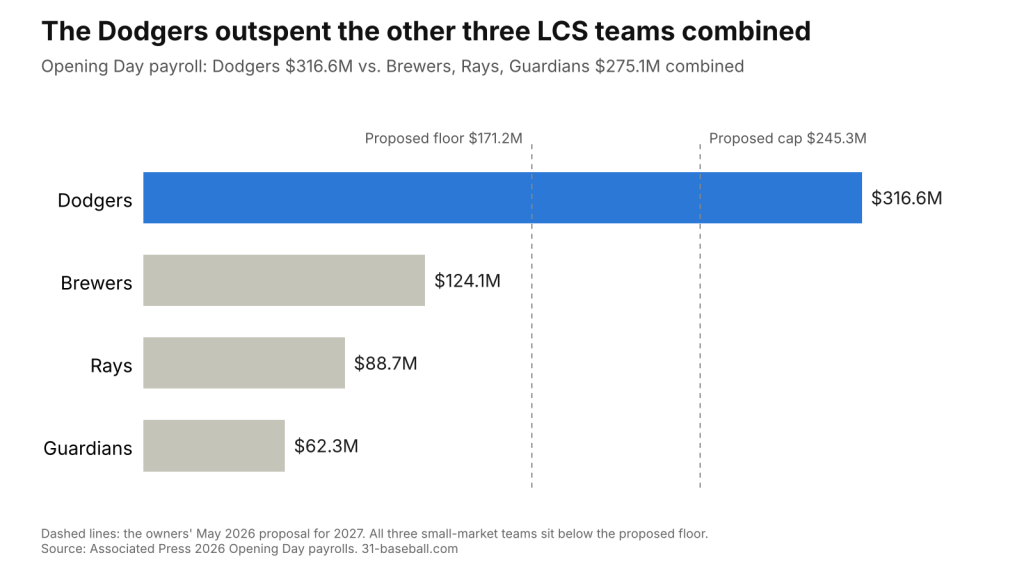
Three of the final four teams spent less combined than the Dodgers alone.
The gap only widened as the season went on. By ESPN’s count, the Dodgers finished with a $340.6 million payroll plus another $180.8 million in luxury tax. That tax bill alone is larger than the entire payroll of the Brewers, the Rays or the Guardians.
The money did not buy October. The Mets, Blue Jays and Tigers, three of the ten highest payrolls in baseball, missed the postseason entirely. The Yankees, Phillies, Padres, Braves and Astros were all eliminated before the LCS. The Rays swept the Yankees in the Division Series, and the Brewers swept the Dodgers for the pennant.
The owners’ best argument
To be fair to ownership, one October does not prove much on its own, and they know it. Their case rests on the long run. Even this year, eight of the ten highest-spending teams made the playoffs. According to ESPN’s Jeff Passan, teams from the ten smallest markets have made up less than a quarter of League Championship Series qualifiers for more than 25 years, and the last one to win a World Series was Kansas City in 2015. Commissioner Rob Manfred has argued that a big-market team’s edge in reaching the playoffs grows with every round once it gets there.
So the response to this World Series is predictable: it is an outlier. A short series is close to a coin flip, and a few hot weeks from a cheap roster should not decide the economics of the sport for the next five years.
That would be a fair point if this were a one-year story. It is not.
This is not a one-year fluke
Since 2016, the Rays, Guardians and Brewers have combined for 22 playoff appearances and eight LCS berths. Milwaukee has won four straight NL Central titles, and the highest it has ranked in Opening Day payroll during its current ten-year run is 17th, back in 2019. The Rays almost always finish in the bottom five. These are not teams that got lucky once. They are three of the most consistent organizations in the sport, and they have done it on a fraction of the money the owners say is required.
They also win in similar ways. Milwaukee and Tampa Bay ranked first and second in batting average this season, and the Brewers led the majors in walk rate and on-base percentage. The Rays struck out less than any team in baseball, and Cleveland ranked fifth. All three finished in the top seven in stolen bases. On the mound, Cleveland has been developing top-tier starters for two decades, and Milwaukee has built one of the best pitching development systems in the game, producing arms like Jacob Misiorowski and Logan Henderson.
Most importantly, they find value other teams miss. Bryan Baker, the Rays’ breakout closer, posted a 1.44 ERA this season after Baltimore traded him away in 2025 for a draft pick. Jake Bauers, Milwaukee’s cleanup hitter, entered 2026 with a career OPS+ of 84 and a below-replacement career bWAR after stops with four other organizations. The Brewers also employ the largest international scouting staff in baseball. None of that shows up on a payroll sheet, which is exactly the point.
Guardians first baseman Nathaniel Lowe, who has played in big and small markets, put it simply: “It’s not a payroll issue. It’s commitment to winning.”
What a cap actually does
If small-market teams can build sustained winners under the current system, a cap is not necessary to make them competitive. So what is it for?
Look at who it constrains. Every owner in baseball already decides how much to spend. Nobody forces the Rays to run a bottom-five payroll, and nobody forces the Mets to spend $350 million. A cap does not give a small-market team a single new dollar. It only limits what the teams at the top can spend, and it does that by limiting what players can earn. Tie that to a fixed 50/50 revenue split, and ownership’s biggest variable cost becomes a predictable one. That is cost certainty, and it benefits the owners.
The details point the same way. The players’ union estimates the proposal would take roughly $550 million out of player pay, in part because benefits and amateur bonus pools count against the “salary” cap. A revised proposal added maximum contract sizes for free agents. Meanwhile, small-market clubs already collect a large share of league revenue through revenue sharing, which critics such as CBS Sports’ Dayn Perry argue amounts to guaranteed profit with little incentive to reinvest in the roster.
The proposed floor is the one piece of the plan that would force low spenders to spend more, and the union has said it is open to one. But a floor does not need a cap attached to it. The cap is the part owners want, and it is the part that saves them money.
Baseball has been here before. The last time owners made a cap the centerpiece of bargaining, in 1994, it led to the longest work stoppage in league history and the cancellation of the World Series.
Four wins from history
On Friday, one of two franchises that have never won a championship starts four wins away from its first. Whichever team gets there will have done it without a salary cap, without a top-ten payroll and without the help the owners insist small markets need.
Baseball’s competitive balance problem is not that small-market teams can’t win. It is that too many owners choose not to try. A salary cap won’t change that. It will only make it cheaper.
Data: Associated Press, ESPN, Bleacher Report, CBS Sports, theScore, Inside Sport, Stadium Rant.


Leave a Reply