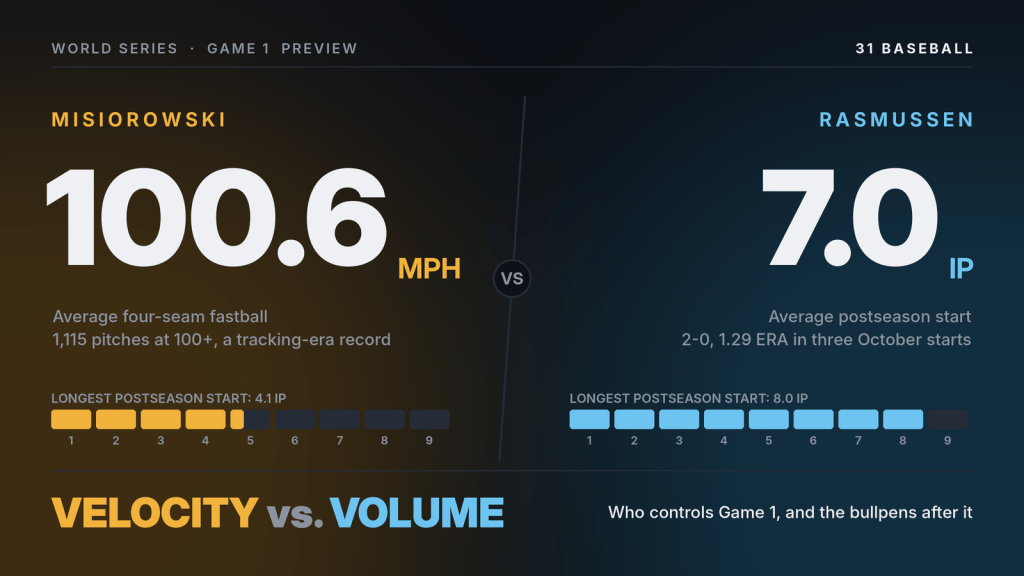
On Friday night, American Family Field hosts the first World Series game in its history, and the Brewers are handing the ball to the most overpowering pitcher in baseball. Jacob Misiorowski went 16-5 with a major-league-low 1.80 ERA, led the majors with 252 strikeouts and is about as close to a lock for the NL Cy Young as it gets. The Rays haven’t officially named their starter, but every sign points to Drew Rasmussen, who would be making his third straight Game 1 start this October.
On paper, it’s ace vs. ace. In practice, it’s two completely different answers to the same October question: how do you get 27 outs? Misiorowski overpowers hitters. Rasmussen outlasts them. And the difference in how long each one stays on the mound could shape far more than Game 1.
The fastest arm of the tracking era
Misiorowski’s season was a velocity record book. He threw 1,115 pitches of 100 mph or more, the most in a single season since pitch tracking began in 2008. The previous record was 673, set by Jordan Hicks in 2018 as a reliever. Misiorowski nearly doubled it as a starter.
He owns the single-game record too. On July 26 against the Rockies, he hit triple digits on 66 of his 83 pitches, topped out at 104.7 mph and struck out the first seven hitters he faced, a Brewers franchise record. His four-seam fastball averaged 100.6 mph for the season.
What made 2026 different from his rookie year is that the fastball finally has company. His slider sits in the low 90s and has been nearly impossible to square up. His curveball gives hitters a completely different speed to worry about, and he added a cutter he threw roughly 10 percent of the time. In August, he struck out Shohei Ohtani with a curveball, a 102 mph fastball and a slider, then got Freddie Freeman on another slider to escape a bases-loaded jam. That is not a thrower. That is a pitcher.
The October problem
And yet, Misiorowski has not made it out of the fifth inning this postseason.
He threw four innings in Game 1 of the NLDS against San Diego and 4⅓ in Game 1 of the NLCS against Los Angeles. He was not hit hard in either start. He allowed three runs total over 8⅓ innings, and the Brewers won both games. The problem was efficiency.
The Padres fouled off pitch after pitch and chased him after four. The Dodgers took the same approach and pushed it further. They fouled off 21 of his 94 pitches. He needed 35 pitches to get through the second inning, his most in any inning all season, and he was at 69 pitches after three. Los Angeles swung at 27 of his 62 fastballs, fouled off 16 and missed just five. His fastball whiff rate in that game was 18.5 percent. During the regular season, it was 40.2 percent.
That is not bad luck. That is a plan. Good October lineups know they are not going to barrel 101 mph at the top of the zone, so they shorten up, spoil it, and make him throw another one. Every foul ball that would have been a whiff in July is another pitch on the count in October.
Why Tampa Bay is built to copy it
This is where the matchup gets interesting. The Rays struck out less than any team in baseball this season and ranked second in batting average. They are a contact lineup, which is exactly the profile that drove Misiorowski’s pitch count up against Los Angeles. If Tampa Bay brings the same approach on Friday, a four- or five-inning start is the most likely outcome.
To be fair to Milwaukee, the Brewers are built for exactly that. Their bullpen has a 1.33 ERA this postseason. In NLCS Game 1, it covered 4⅔ scoreless innings to hold on for a 2-1 win. Pat Murphy does not need seven innings from Misiorowski. He needs 12 to 15 dominant outs and a lead, and then he has the best relief corps left in the tournament to finish it. A short Misiorowski start is not a loss. It is a bill the Brewers pay later in the series.
The workhorse in an opener’s world
On the other side is the most underrated ace in baseball. Rasmussen went 16-5 with a 2.67 ERA and an AL-best 0.91 WHIP over 172 innings. He was even better in the second half, going 11-0 with a 1.73 ERA in 15 starts after the All-Star break, and Tampa Bay has won 14 of his last 15 starts.
His October has been about length. In Game 1 of the ALDS against the Yankees, he carried a no-hitter into the eighth inning and became the first pitcher in Rays history to complete eight innings in a playoff game, a 1-0 win. He gave up two runs over six in ALCS Game 1, then allowed one run over seven in Game 5 at Cleveland to put the Rays one win from the pennant. That’s 2-0 with a 1.29 ERA, 23 strikeouts and three walks over 21 innings, an average of seven innings a start. Through the ALCS, there had been only five outings of seven or more innings in the entire 2026 postseason. Two of them were his.
The irony is hard to miss. This is the franchise that popularized the opener in 2018. This is the franchise that pulled Blake Snell in the sixth inning of Game 6 of the 2020 World Series, with a lead and his pitch count in the 70s, and watched the Dodgers rally to win the title. And just a year ago, the Rays were managing Rasmussen’s workload so carefully that he went more than five innings in only eight of his 31 starts. Now the most analytically driven organization in baseball is riding its starter deep into October games, and it is working.
Three fastballs and a changeup
Rasmussen gets there with a completely different blueprint than Misiorowski. He throws three fastballs: a cutter around 90 mph that he commands low and glove-side, a four-seamer around 96 and a sinker around 95 with heavy arm-side run. He throws each of them between roughly a quarter and a third of the time, so hitters see the same release and the same speed band, with the ball breaking in three different directions.
The pitch that changed this year is the changeup. He now throws it about 13 percent of the time, and it has given left-handed hitters something new to worry about. Tampa Bay has quietly become one of the best changeup-development organizations in the sport, and Rasmussen said better command of the changeup was the biggest difference in his Game 5 win over Cleveland. His curveball and sweeper show up less than 4 percent of the time.
That mix explains the length. Misiorowski wants swings and misses. Rasmussen just wants swings. With a 4.8 percent walk rate, he lives in the zone, gets early weak contact and keeps his pitch count low enough to see a lineup a third time. Against a Brewers offense that led the majors in walk rate and on-base percentage, that strike-throwing will be tested. But it is a far more sustainable formula in October than relying on hitters to miss.
The bullpen math
This is where Game 1 starts to matter for the rest of the series.
The Rays leaned heavily on their rotation to get through the ALDS and ALCS. Freddy Peralta, Griffin Jax and Ian Seymour all came out of the bullpen at some point, and Peralta’s relief outing in ALCS Game 4 replaced a side session. Closer Bryan Baker has been nearly perfect, with seven scoreless innings and five saves this postseason. But a bullpen that has been borrowing starters needs a night off.
If Rasmussen gives the Rays seven innings Friday, Tampa Bay needs only six outs from its bullpen, likely Baker and one setup arm. Peralta stays on track to start Game 2 on normal rest, Nick Martinez and Jax stay in their starting roles, and every key reliever is fresh heading into the middle of the series. Rasmussen would also line up for a potential Game 5 start, giving the Rays two games where they can reasonably expect to cover the first seven innings with one pitcher.
Milwaukee does not have that luxury. If Misiorowski goes four or five, the Brewers’ bullpen is covering 12 to 15 outs in Game 1 and likely more of the same if he starts Game 5.
One caveat: rest. Rasmussen’s three postseason starts came on 10, eight and five days of rest. Friday would be his first October start on a standard four days. The Rays have protected him all year for a reason, and his fastball velocity in the first two innings is worth watching.
The verdict
I’m not picking Game 1. It’s a genuine style clash, and either one of these pitchers could decide it on his own. If Misiorowski is missing bats early, the Rays’ contact approach won’t matter. If Tampa Bay runs his pitch count up again, Rasmussen could outlast him by three innings.
Over the full series, Rasmussen’s ability to save the Rays’ bullpen is the best structural edge Tampa Bay has. But Milwaukee won 103 games, swept the two-time defending champions, has the deeper bullpen and gets home-field advantage. Even a short Misiorowski start is 12 to 15 outs that the Rays have rarely done anything with, and he’ll likely get the ball twice.
Brewers in six.
Misiorowski will win the radar gun on Friday. Rasmussen might win the clock. Over six games, I think the radar gun and the bullpen behind it win the series.
Data: MLB.com, Associated Press, ESPN, Sports Illustrated, Tampa Bay Times, Dodger Blue, Just Baseball, ClutchPoints, Screwball, Yahoo Sports, TampaBay28.


Leave a Reply