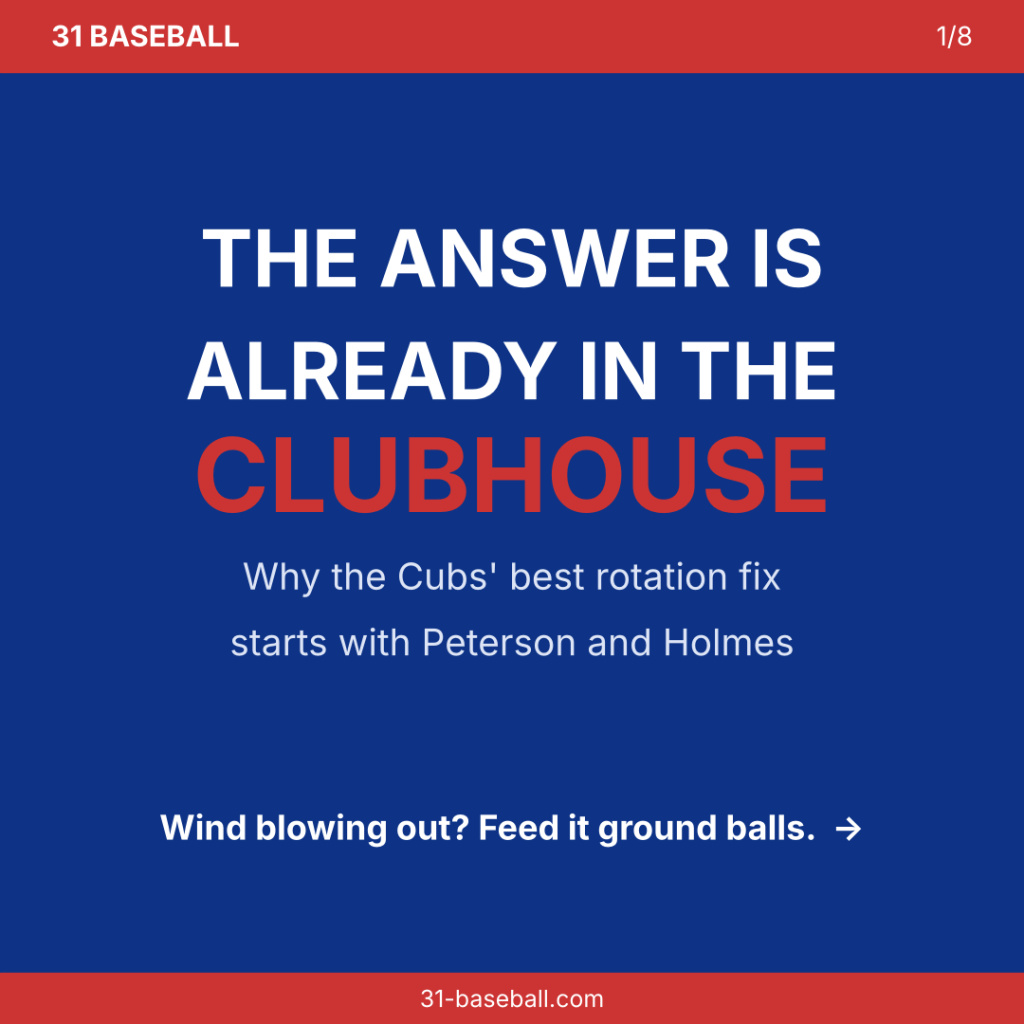
Every Cubs fan knows the feeling. The flags in center field are snapping toward the bleachers, the wind is blowing out, and a routine fly ball turns into a souvenir. That problem hurt the Cubs last year, when Jameson Taillon and Shota Imanaga were too often on the wrong end of the wind. Imanaga has allowed more home runs than any pitcher in baseball over his three seasons.
So as the Cubs shop for starting pitching this winter, the profile should be simple: pitchers who keep the ball on the ground, or pitchers who keep it out of play entirely with strikeouts. Ideally both.
There’s a second reason the profile fits. The Cubs had the best defense in baseball in 2026, and it wasn’t close. They finished first with 115 Defensive Runs Saved, well ahead of the second-place Rays at 87. They also led MLB with 74 Outs Above Average, topping the previous Statcast-era record of 66 set by the 2017 Twins. Pete Crow-Armstrong leads the way in center, but the infield is elite too: Dansby Swanson, Nico Hoerner, Alex Bregman and Michael Busch all rated above average. That’s why ground balls matter so much at Wrigley. The wind can turn a fly ball into a home run, and no defense can catch a ball that lands in the bleachers. But a ground ball stays in the park, and it goes straight to the best defense in the game. Every grounder is a chance for those 115 runs saved to go to work. A fly ball pitcher hands the game to the wind. A ground ball pitcher hands it to the defense.
With that lens, the best options aren’t the biggest names on the market. They’re two pitchers who finished the season in a Cubs uniform.
From Within: David Peterson
Peterson should be the Cubs’ first call. Across 148 innings in 2026, he posted a 50.1% ground ball rate and allowed fly balls only 28.2% of the time. That’s no fluke, either: his career ground ball rate is 51.3%.
His 4.79 ERA looks ugly, but it hides the real story. With the Mets, hitters batted .350 on balls in play against him, and his ERA ballooned to 6.09. After the trade to Chicago, with the best defense in baseball behind him, that number fell to .293. That’s the defense at work, turning his ground balls into outs. With the Cubs, he posted a 3.70 ERA, a 21.5% strikeout rate and an ERA- of 90, about 10% better than league average. His FIP for the full season was 3.96.
The flaw is walks, at nearly 10%. But he’s a lefty, he already knows Wrigley, he made just $8.1 million last year, and he’s exactly the kind of pitcher this defense is built for.
From Within: Clay Holmes
If Peterson is the value play, Holmes is the ground ball specialist. His 60.7% ground ball rate in 2026 was among the best of any starter, and he allowed just 0.53 home runs per nine innings. Over the past two seasons, his ERA+ of 119 ranked among the better marks in baseball.
The concern is strikeouts. His 18.6% strikeout rate is below average, and it dipped to 16.2% after the trade, with his sinker sitting around 93 mph. That’s why he should be signed on a short deal, not a long one. Holmes declined his $12 million player option, and a deal close to that number makes sense. Paired with the Cubs’ infield, his grounders become outs.
The High End: Michael King
If the Cubs want a bigger name, King is the most realistic option. He made 32 starts, threw 185 innings, and posted a 3.21 ERA with an ERA- of 80. He’s a proven workhorse with postseason experience.
The flaws are real, though. His 4.13 FIP and 4.40 expected ERA say he pitched closer to a 4.00 ERA than his surface numbers. His strikeout rate has fallen from 27.7% in 2024 to 21% in 2026, and his fly ball rate was nearly 39%, with Petco Park likely hiding some of that. He declined a $28 million player option, so he won’t be cheap. He’s the best of the high-end group, but the Cubs should go in with their eyes open.
The High End: Tarik Skubal
Skubal is the best pitcher on the market, and it isn’t close. He struck out 30% of hitters, walked just 4.4%, and posted a 2.72 ERA backed by a 2.51 FIP. His ERA- of 65 means he was 35% better than league average, and this was his third straight elite season. He even gets enough ground balls, at 43.1%, to pair well with the Cubs’ defense.
The problem is the price. Skubal made $32 million last year and is likely looking at $35 million or more per year over a long-term deal. That would be by far the largest contract in Cubs history. The current record is still Jason Heyward’s eight-year, $184 million deal, and the Cubs have never spent more than $200 million on a single player. A Skubal deal in the range of $245 million to $280 million would blow past Heyward by $60 million to $100 million. He’s the dream, but it’s hard to see the Cubs writing that check.
The High End: Freddy Peralta
Peralta’s track record is impressive, with three straight 200-strikeout seasons before 2026. But the trend lines are going the wrong way. His strikeout rate fell from 28.2% in 2025 to 21.4% in 2026, and his ground ball rate was just 39.4%, with 37% for his career. He gave up 1.22 home runs per nine innings and finished with an ERA- of 107, worse than league average.
A fly ball pitcher with fading strikeouts is exactly the wrong profile for Wrigley, and he still projects to get around $25 million a year. Pass.
The Bargain Bin: Nick Martinez
Martinez gets called underrated, and his 2026 ERA ranked 14th among qualified pitchers. But he posted the lowest strikeout rate of any qualified starter and one of the lowest ground ball rates in baseball. His low home run rate is the kind of thing that rarely sticks without grounders or strikeouts to support it. At Wrigley, that combination is a risk.
The Bargain Bin: Martín Pérez
Pérez had a 3.04 ERA in 142 innings for Atlanta, but his 4.32 FIP and 4.51 expected ERA point to a lot of luck. He’s 35, his 17.1% strikeout rate and 10.4% walk rate are both well below average, and a back injury kept him out of the NLDS. His 45.7% ground ball rate is solid, which makes him reasonable depth, but not a rotation answer.
The Bargain Bin: Tyler Mahle
Mahle’s 1.99 ERA after his trade to Atlanta looked like a breakout, but his expected ERA in that stretch was 3.59. For the full season, he had a 3.99 ERA, a league-average ERA- of 97, and gave up 1.21 home runs per nine innings. His 44% ground ball rate is only average. When the wind blows out, he looks a lot more like Taillon than Holmes.
The Verdict
The Cubs don’t need to win the winter with a splashy signing. They need pitchers who fit their park and their defense. Bring back Peterson and Holmes first: they get ground balls, they’re affordable, and they’ve already shown they can pitch in front of this infield. From there, King is the best high-end option if the price is right, and Skubal remains the dream, if the Cubs are ever ready to make history with a contract.


Leave a Reply