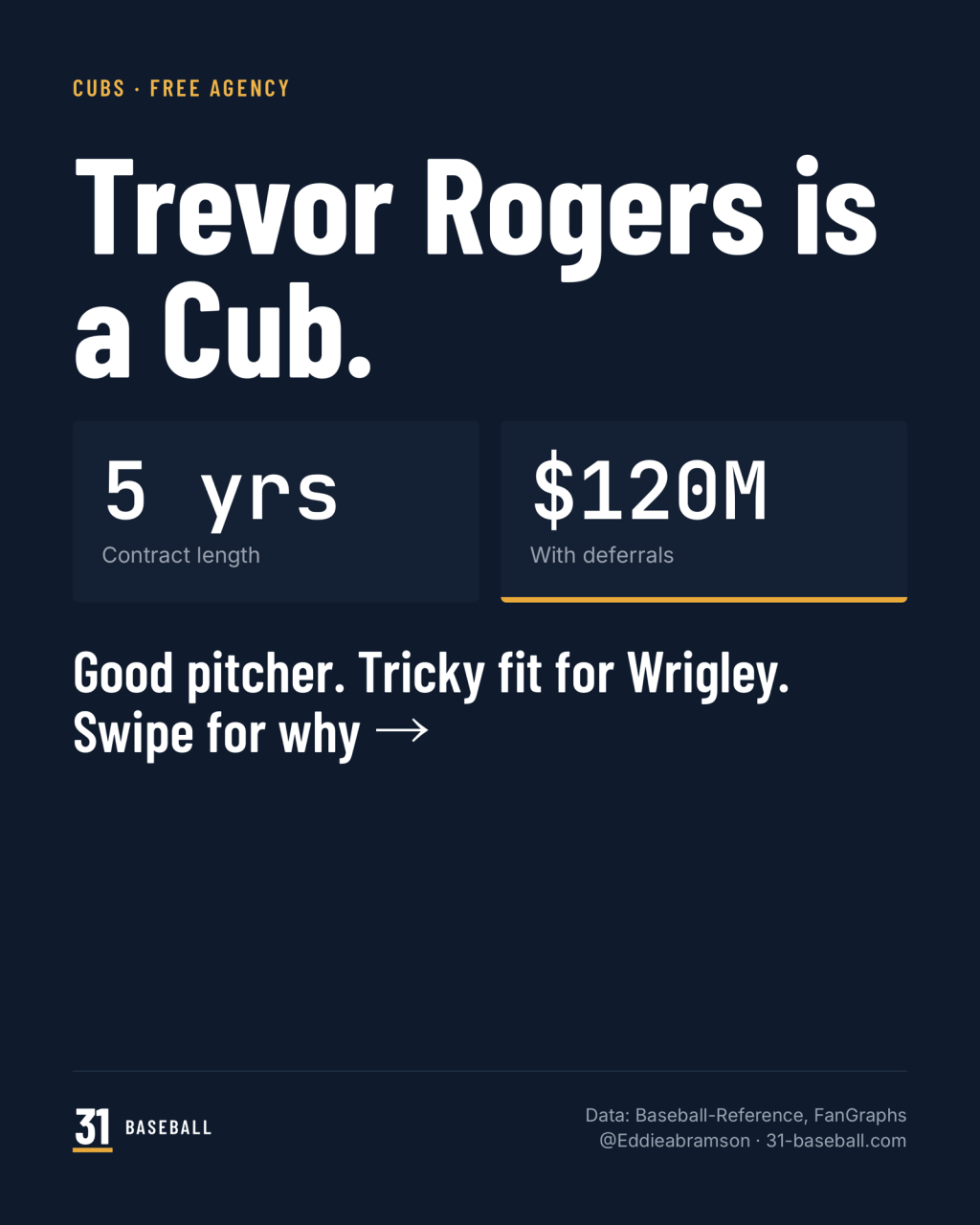
The Cubs finally made their big pitching move. Trevor Rogers is coming to Chicago on a five-year, $120 million deal with deferrals. Rogers was one of the two or three best starters on this winter’s market, and the Cubs needed him badly. Their rotation was thin after a wave of departures, and Rogers now slots in near the top of it.
The question isn’t whether Rogers is good. He is. The question is whether he’s the right kind of good for Wrigley Field, and what this signing says about where the Cubs keep going shopping.
Who Rogers Actually Is
Rogers has had a strange career. The Marlins took him 13th overall in 2017, and he broke out in 2021 with a 2.64 ERA, an All-Star nod and a second-place finish in Rookie of the Year voting. Then came injuries, a 5.47 ERA in 2022, a lost 2023, and a 4.92 ERA in 2024 split between Miami and Baltimore.
Then 2025 happened. After coming back from the IL, Rogers posted a 1.81 ERA over 109.2 innings and finished ninth in AL Cy Young voting. It was brilliant, but it wasn’t all real. His FIP was a full run higher at 2.82, and hitters made a lot of hard contact that just happened to find gloves.
In 2026 the luck evened out. Over 30 starts and 169.2 innings, he put up a 4.03 ERA with a much better 3.45 FIP. He had a rough opening stretch and missed time with an illness, but from there he finished strong: a 2.90 ERA, a 24.8% strikeout rate and a 4.4% walk rate over the final four months.
The real change in Rogers is his command. In 2024 he walked 4.1 batters per nine innings. In 2025 that dropped to 2.4, and in 2026 to 2.1. That isn’t luck. That’s a pitcher who learned to throw strikes, and it’s the best case for giving him $120 million.
The Wrigley Problem
Rogers is a strike-thrower, not a strikeout pitcher. His 2026 strikeout rate was 22.5%, solid but not elite. And for the full season his ground ball rate fell to 38.3%, the lowest of his career.
That’s the part that should make Cubs fans a little nervous. A fly-ball lefty who lives in the zone is exactly the pitcher who gets burned on the days the wind blows out at Wrigley. To his credit, Rogers doesn’t give up a lot of homers on his fly balls. His 8.8% HR/FB rate in 2026 was better than average, and his career mark is 9.1%. The worry is how many fly balls he allows, not how hard they’re hit.
You might expect his strong finish to have come with more ground balls. It didn’t. Rogers’ ground ball rate was 38.1% in the first half and 38.5% in the second, basically no change. His better results came from command: fewer walks and more strikes on the same mix of contact. That’s encouraging, because command tends to stick. But it also means the Wrigley concern doesn’t go away. The pitcher who dominated the final four months is the same fly-ball pitcher who’ll be at the mercy of the wind on certain afternoons.
So he isn’t a perfect Wrigley fit, and his best stretch last year didn’t change that. He is a quality pitcher who has performed before, and the Cubs are betting his command is good enough to make the fly balls a manageable cost.
The Marlins Pipeline
Rogers isn’t the first former Marlin the Cubs have brought in lately. He’s the third in about a year.
Last offseason the Cubs traded for Edward Cabrera, sending top outfield prospect Owen Caissie plus infield prospects Cristian Hernandez and Edgardo De Leon to Miami. At the deadline they went back for Braxton Garrett, a lefty still working back from elbow surgery. Now Rogers, a Marlins draft pick and product of their system, gets the biggest pitching contract the Cubs have handed out in years.
And then there’s Sandy Alcántara. The Cubs have been repeatedly linked to the former Cy Young winner for the past couple of years, at the 2025 deadline, over last winter and again this July. Most of that has been informed speculation rather than confirmed talks, but the connection keeps coming up for a reason.
This doesn’t look like coincidence. Miami has a long record of developing pitchers with good raw stuff, and the Cubs’ front office seems to trust that foundation, buying Marlins-developed arms and betting they can refine them further. Rogers fits that profile exactly: a former first-rounder whose talent was never in question and whose command finally caught up.
There’s a warning in here too. Cabrera came to Chicago off a career-best season, and his first year as a Cub was a disappointment. The front office has openly said it needs to get more out of him. Liking another team’s development system is one thing. Turning those pitchers into winners in Chicago is another.
The Bottom Line
Rogers is a good signing at a fair price, close to what most projections expected. He isn’t a perfect stylistic fit for Wrigley, and his ground ball rate barely moved even during his hot finish, so the fly-ball risk comes with the deal. But his command gains look real, and a strike-throwing lefty who has performed before is worth the money for a rotation this thin. Keep an eye on the Marlins trend, too. If Alcántara ever ends up in Chicago, nobody should be surprised.


Leave a Reply