Down 4-0, and nobody panicked
The Brewers’ comebacks are mostly a bullpen skill, not October luck. In World Series Game 2, Tampa Bay scored four in the first off rookie Logan Henderson. Milwaukee then scored five unanswered runs and won 5-4, while the bullpen threw six shutout innings.
That makes seven wins in the eight October games Milwaukee has trailed. They’re 9-1 in the postseason and lead the Series 2-0. Teams up 2-0 in a best-of-seven have won 83.2% of the time.
The easy line is “this team just has it.” The better question is whether “comeback team” is something you can actually build.
The narrative vs. the numbers
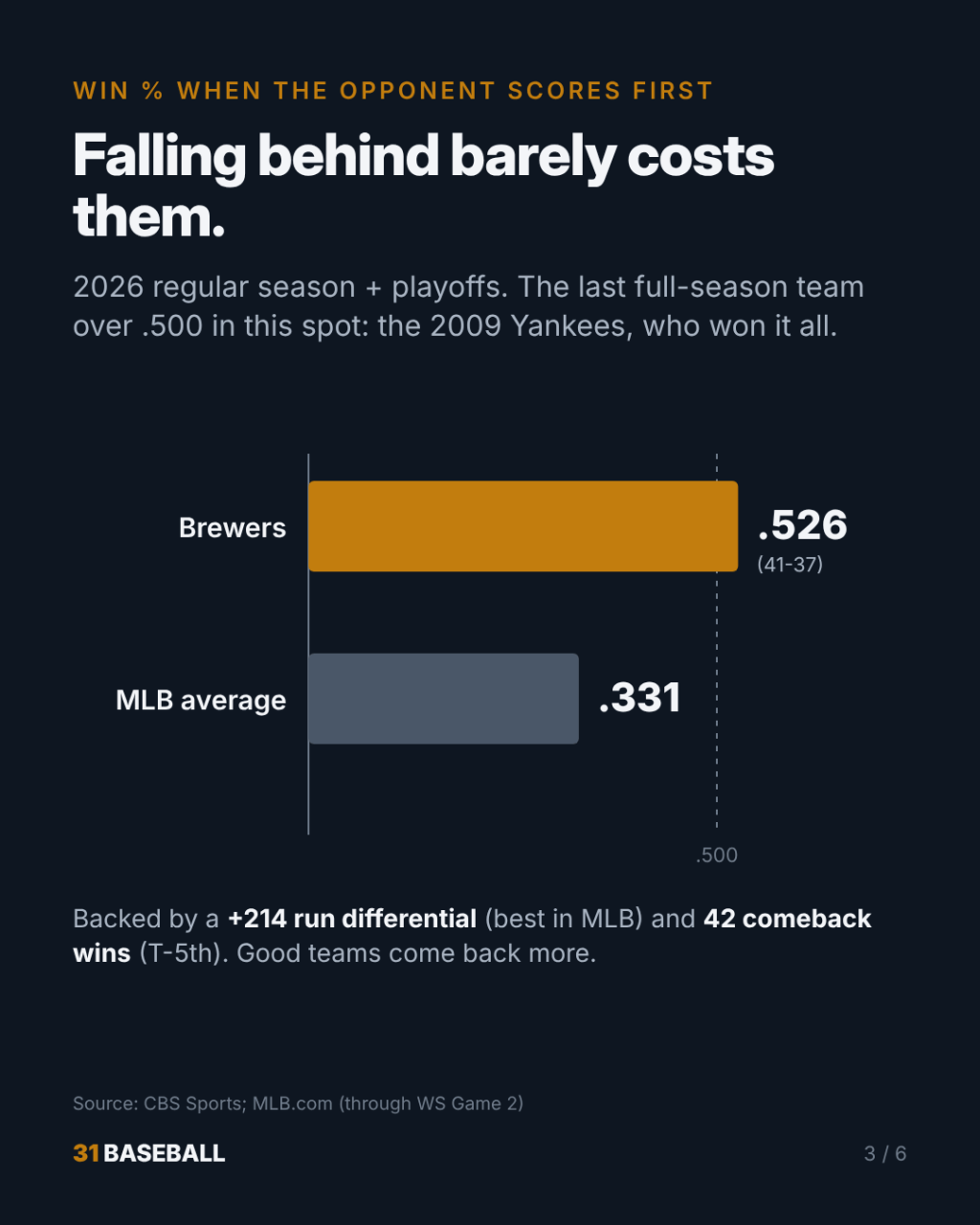
Winning after the other team scores first is normally regression bait. Milwaukee hasn’t regressed. Across the regular season and playoffs they’re 41-37 (.526) when the opponent scores first. All of MLB went .331 in that spot this year (CBS). The last full-season team with a winning record in those games was the 2009 Yankees, and they won the World Series (MLB.com).
A one-month hot streak can look like that. A full season mostly can’t. The Brewers had 42 regular-season comeback wins (tied for fifth in MLB) and a +214 run differential, the best in baseball (CBS). Good teams come back more because they’re good, and the run differential says this team is very good.
The offense is built for it too. Milwaukee was 2nd in runs (832) and 1st in OBP (.341) while hitting just 154 home runs, tied for 28th (FOX Sports). A lineup that gets on base and runs (162 steals) keeps scoring after it falls behind. It doesn’t need one big swing. Sal Frelick put it simply after Game 2: the offense is built to “chip away and wear on pitchers.”
Why this one is real: the bullpen
Falling behind only stops costing you if the other team stops scoring. Milwaukee’s bullpen makes that happen. It had a 3.40 ERA in the regular season, 3rd in MLB (FOX Sports). Then it got better: a 1.33 postseason ERA entering the World Series, with relievers averaging 98 mph on the fastball, the highest of any playoff team (MLB.com).
This isn’t one hot arm. The depth runs through the whole staff:
- Abner Uribe: 1.80 ERA since 2025, second among 110 relievers with 100+ innings (only Aroldis Chapman is lower). He hit 100.3 mph with his sinker in Game 1.
- Trevor Megill: About a 50% whiff rate on his curveball over the last three seasons.
- DL Hall: 1.91 ERA and 64 K in 61⅓ regular-season innings.
- JoJo Romero: 9 K and 1 BB in 19 postseason batters faced.
Then there’s Aaron Ashby. He has thrown 15⅔ scoreless innings to open the postseason, with 5 hits, 3 walks and 17 strikeouts (CBS). His slider had a 56.6% whiff rate in the regular season, 3rd among pitch types with 50+ swings.
| Pitcher | Year | Scoreless IP to open a postseason |
|---|---|---|
| Andrew Miller | 2016 | 16 |
| Aaron Ashby | 2026 | 15⅔ (active) |
| Andy Hawkins | 1984 | 15⅓ |
| Goose Gossage | 1981 | 14⅓ |
One more out ties Miller. That 2016 comparison fits: Cleveland’s Miller run is the model for a manager using a dominant reliever whenever the game turns, not by inning. Ashby has gone five outs in both World Series games.
The twist: the slow bullpen misses more bats
Velocity explains a lot of Milwaukee’s bullpen, but not all of it. Across the field, Tampa Bay’s relievers are the slowest of any playoff team, yet they’ve struck out more hitters this October (MLB.com).
| Postseason bullpen (entering WS) | Avg FB velo | Whiff% | K% |
|---|---|---|---|
| Brewers | 98.0 mph | 28.9% | 24.5% |
| Rays | 93.2 mph | 29.0% | 26.7% |
So the gap between these pens isn’t strikeouts. It’s what happens on contact, and who’s on base when it happens. Ian Seymour has let six of seven inherited runners score this postseason. Cam Booser stranded the bases loaded in Game 2, but Frelick took Seymour deep to tie it in the sixth (CBS). Tampa’s defense hasn’t helped: errors and misplays fed Milwaukee runs in Game 2 (CBS).
Verdict, and what to watch in Game 3
It’s a skill, with a small asterisk. The base is real: a +214 run differential, an OBP-first lineup and a deep, hard-throwing bullpen. Winning 7 of 8 games after trailing is still more than that base would predict, and some of it is Tampa’s defense handing over outs. Expect fewer comebacks from here, but don’t expect the Brewers to fold when they fall behind.
Game 3 tonight in St. Petersburg (7 p.m. CT, FOX) is a good test:
- Freddy Peralta vs. his old team. He’s 7-0 with a 0.89 ERA over his last 10 outings and has a 1.10 ERA in his last six starts at Tropicana Field (MLB.com). If the Rays score early, we see how the comeback machine works on the road.
- Ashby’s next out. One more ties Andrew Miller; two breaks the record.
- Bullpen workload. Ashby has gone five outs in each of the first two games. A third straight long outing would be a lot to ask.
- Tampa’s park. The Rays went 59-27 at Tropicana Field this year, including the playoffs.
Stats current through World Series Game 2 (Oct. 24, 2026). Sources: MLB.com, MLB.com bullpen breakdown, CBS Sports, CBS Sports (Ashby), FOX Sports, ESPN.


Leave a Reply